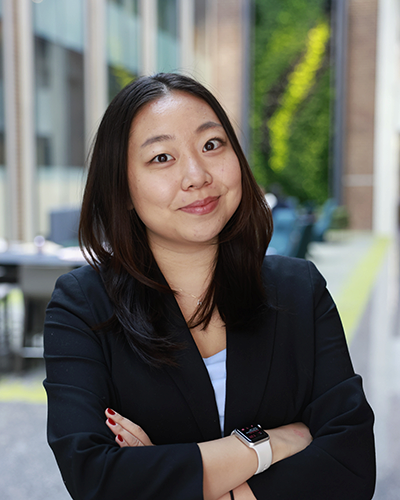


Why would a successful cardiothoracic surgeon get her MBA at Wharton? For Dr. Sarah Minasyan, MD, WG’23, the answer traces back to a Russian saying she grew up with: “Live 100 years, learn 100 years.”
Her path to Wharton — and to the operating room — was shaped long before medical school. Raised in the former Soviet Union, she experienced political and personal upheaval in her teenage years. After the fall of the Iron Curtain, the country she had been taught to trust began to crumble. During that same period, she lost her father to brain cancer.
Her mother, recognizing both the shifting political landscape and the need for a different future, made the life-altering decision to leave. It took six years and a complex web of bribes, but they finally received permission to emigrate. “When we left, we had almost nothing,” Sarah recalls. “My parents were scientists, and the most expensive things in our home were books.”
In the U.S., she accelerated quickly, learning English, graduating valedictorian, and earning her undergraduate degree from UCLA. Her interest in medicine stemmed from both practicality and inspiration.
“Living in Russia, I saw how the world can quickly change,” she says. “But the human body does not change. If I ever needed to start over in another country, I could continue practicing medicine because it is universal.”
As for inspiration, a family friend who was a renowned congenital cardiac surgeon “walked on water” in the eyes of her community. Watching a highly respected master surgeon at work sealed her career choice of cardiothoracic surgery.
Recognizing a Knowledge Gap
For years, Sarah thrived in high-stakes surgical environments. But over time, she observed a growing challenge. Physicians and
administrators, she realized, often spoke two different languages. “Hospital administration spoke business, and I didn’t understand that language,” she says. “Yet as a surgeon, you work within complex systems. You have to engage with the business side whether you intend to or not.”
When the COVID-19 pandemic hit, the mother of four saw both a crisis and an opportunity. “I realized this was the time to learn the language of business,” she says. “And if I was going to do it, I wanted to learn from the best.”
Her husband, also a surgeon, helped her research programs. When they saw that Wharton offers a San Francisco cohort, the decision was made. She applied only to Wharton. “It was an investment in myself. Go big or go home.”
Stretching to Meet a New Challenge
Sarah entered Wharton with an MD and years of surgical leadership, but she describes her early coursework with humility: “Many of my classmates were engineers or deeply immersed in the business world. I had so much catching up to do.”
Her classmates quickly became a source of support, especially during weeks when she was juggling major surgeries and exams. “I’ve operated in teams my whole career, but this was a new kind of team. It was phenomenal,” notes Sarah.
Sarah also came to appreciate how her clinical background offered unique value. She explains, “Surgeons make critical decisions with limited information every day. That translates directly into business leadership. I didn’t realize how relevant that instinct was until Wharton.”
Global Perspective and Applied Impact
Although COVID canceled her planned Global Business Week in Sweden, Sarah refused to let the opportunity disappear.

Instead, she designed her own independent study and traveled there anyway, with Prof. Guy David (Alan B. Miller Professor; Chair, Health Care Management Department) advising her project. She used the Wharton network to connect with Swedish health leaders and investigate why Sweden’s heart failure readmission rates in rural areas are dramatically lower than those in the U.S.
Her findings were illuminating: remote monitoring, telehealth, and mail-in labs formed the backbone of Sweden’s success. “The prototype is there,” she notes. “Adopting similar models in the U.S. would require policy changes, but it’s possible — and it would save lives and reduce costs.”
Following graduation, Sarah was recruited by Utkars Jain, WG’25, to the clinical advisory board of HEARTio, an AI startup aiming to address one of the biggest bottlenecks in emergency medicine: rapid triage of chest-pain patients. “If you can accurately triage patients early, you free up beds, reduce costs, and improve outcomes. It aligns perfectly with my expertise and Wharton’s emphasis on operational impact,” she says.
The Value of a Wharton MBA
For Sarah, the value of the Wharton MBA is about opening new worlds:
- Career relevance: “I now understand how hospitals run from a business perspective. I can speak the language. That changes everything.”
- Expanded networks: “You open a new world for yourself from CEOs and innovators to policymakers. The Wharton brand opens doors.”
- Family benefit: She often jokes that the degree is also an investment in the next generation because the network benefits her kids as well as her classmates’ children.
- Personal growth: “You keep on learning. You stay curious. That matters.”
“Consider it an investment in yourself and in your future influence,” she says. “If you want to lead, if you want a seat at the table, you need the knowledge and confidence to speak the language of business. Wharton gives you that and more.”
By Meghan Laska
Posted: January 5, 2026
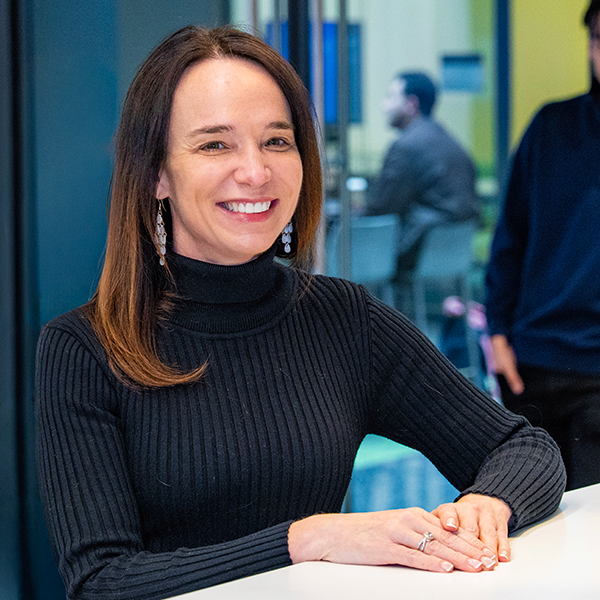
 Image Credit: Brian Kantorek